
Focus - The Way We Were
Reflections from CFUW Members
Mary Gail (MacDonald) Crawford
1932
My younger sister and I were born in an Atlantic fishing town of 4,000 souls at the beginning of the Depression. For the most part, we had an unremarkable happy childhood but by the end of the Thirties it was a different story. As naive children, we were untroubled by the outbreak of WW2 but our parents must have had to hide their anxiety. At the bottom of our street was a dry dock for repairing fishing boats and for the next few years, naval corvettes and destroyers crowded there for reconditioning. Overhead were squadrons of Spitfires and Lancaster bombers making their way overseas which we learned to identify from their outlines in the sky. To us, guessing was a game.
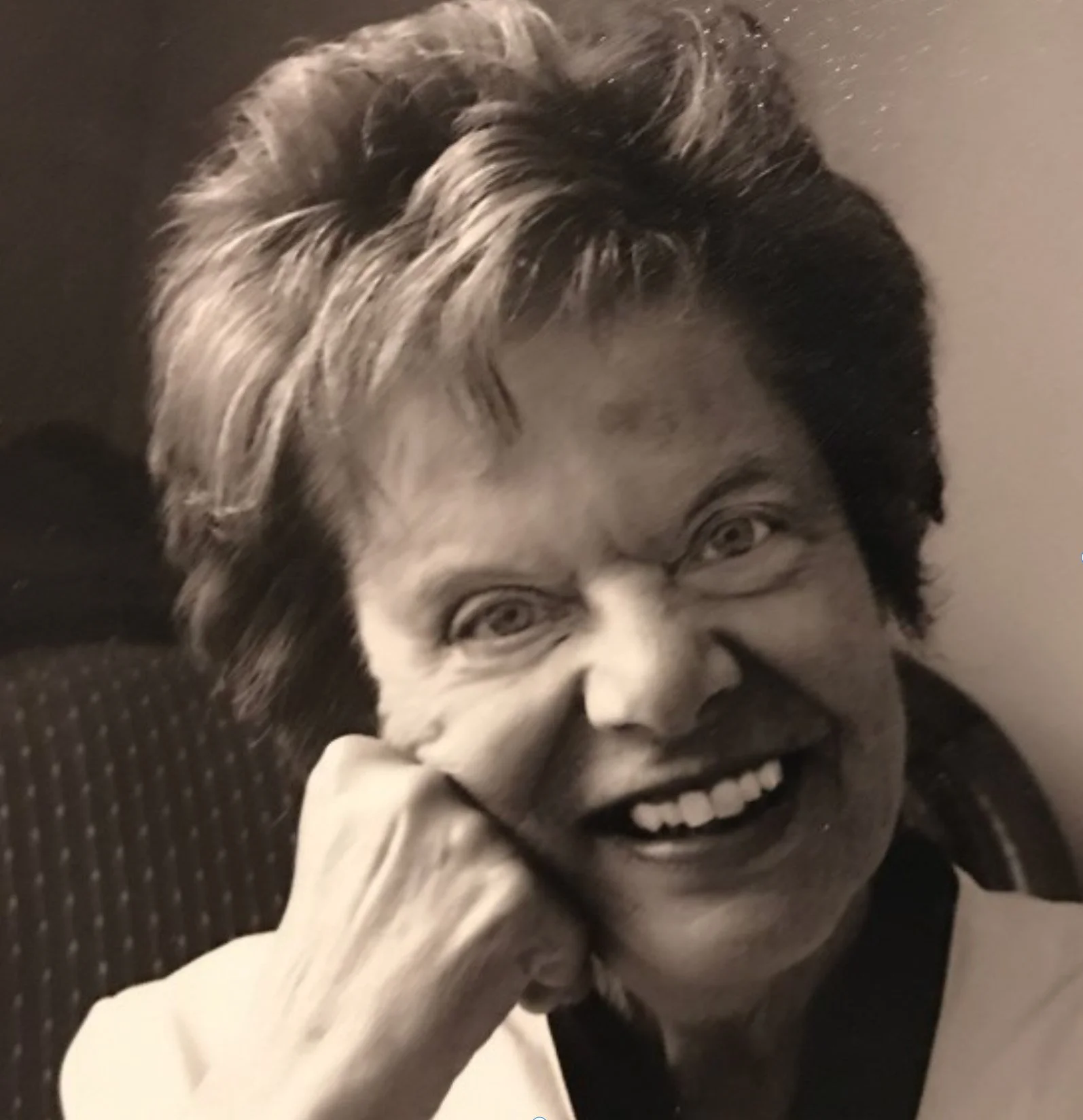
At home, we soon had black window blinds at night so the enemy would not recognize anything. Soon our mother was mailing food parcels to her cousins in Ireland. Soon, too, we had food rationing, learned to make eggless cakes and collect food stamps; food staples were sent regularly to England. This largesse was often in vain because German submarines doggedly patrolled the Atlantic Ocean and sunk merchant ships. Crews were lucky if they made it to dry land, half frozen and hungry. There were many stories about German spies put ashore at night when the rest of us were sleeping. Their mission was to map the coastline; fortunately, many were caught. Only as adults did we learn that we had experienced the Battle of the Atlantic. Our mother read The Halifax Herald each day and taught me European geography through maps showing the Axis and Allies in battle in Europe.
The war at an end, we moved to Cape Breton as our Father decided to work with his brothers who were in wholesale grocery distribution based in Sydney. We located in Sydney Mines, and nothing prepared us for a dreary life in a coal mining town. Life for fishermen was hard enough but mining coal miles under the ocean was indescribable. In a few years our father moved again to an agricultural town in southern New Brunswick which was infinitely more agreeable. I completed my grade 11 and discovered that I had a flair for English and History. My father arranged my first job working for the local weekly newspaper. After 18 months there, I was ready for university and I chose Dalhousie in Halifax as I was interested in pursuing Law -- eventually. Armed with a small scholarship from the University of King’s College on the Dalhousie campus, and my savings from journalism, I headed east.
In those days we were expected to apply ourselves to the classroom so that most of us did not have jobs on the side. That came later. We lived frugally as meals were provided as part of our tuition. No ordering in of pizza! If we went to a movie, it was a treat because money was scarce. There were extra curricular activities and I tended to major in those and cram in knowledge at exam time. Favourites were drama, debating and later the yearbook; and, as part of the mandatory exercise regime, play field hockey or try to. We scored no goals during my tour of duty. The girl’s residence, Alexandra Hall, was used during WW2 as a residence for the WRENS. Our Dean of Women used the naval instruction book to govern coeds in peacetime. Her heavy handedness was so unreasonable that we took our cause to the President and she was replaced.
There was no particular anti-female bias during my time that I could detect. There might have been in Science and Math and certainly in the Law School, but I was in Arts which was always an accepting field. As long as you were prepared to do the work, the job was yours. Thus, in my third year, I became Editor of the yearbook -- the first woman to do so at King’s, an Anglican university that had been decidedly male dominated.
While pursuing knowledge, most of us had summer jobs waitressing although we were not nimble-fingered enough to totally master French Service at the fancy resorts . I spent two summers at the Digby Pines Hotel in Nova Scotia, and a summer at Le Manoir Richelieu in Quebec in an effort to improve my French, futile because most staff spoke English. After graduation I joined CBC Radio in Halifax and later took a summer job at the Banff Springs Hotel to earn money for travel overseas. My 18 months living and working out of London were, in hindsight, character building and mind opening. I was the first person in my family to do so and eventually became self-confident. I wrote airmail letters on onion-skin paper to my mother so she would not worry. Of course, I did not tell her everything because there were some narrow escapes. Where we experienced males with attitude was in Spain and Italy; enticing women was a game in Italy, in Spain it was threatening.
I never made it to law school but I did obtain a master’s degree in history instead. One of the younger professors in his insecurity favored the male students when marking essays. By then I was old enough to be his mother so I may have been a threat. None of the other professors showed any favouritism. I went on to become a researcher, editor and writer of nonfiction.
Connie Young
aged 101 years, B.Sc., 1943 McGill University
in conversation with her daughter, Margaret Hinton, November 2023
In my family of 4 (3 girls and one boy), my father felt strongly that higher education should be an integral part of our upbringing but financially, he could not afford to send us away to university. Society at that time did not think higher education was useful for women and in fact only two other girls and one boy in my high school class went on to university. At Cambridge University, for example, girls could take university courses but would not be granted a degree until 1948, very different from Canada.
My sister, a high school graduate at 16, was too young to be admitted to her chosen field of nursing so my father insisted she attend university, first to study teaching, after which she then went on to nursing. At 17, I wanted to study the science of Home Economics and enrolled at nearby McGill University’s MacDonald Campus in Ste Anne de Bellevue, a beautiful campus with lots of social life… tea dances and formal dances and in winter, a large skating rink. The social life was great until second year when all the young men left to join the war.
I enjoyed my courses and even found some fascinating…especially when I worked with rats to see how they were affected by different diets…and the results were immediate! As part of third year, we had to “volunteer’ to work at the downtown Eaton’s store on Saturdays just before Christmas…to understand retail!! I was sent to the Linen Department… interesting, but like all the others, I wanted to catch that early evening train back to campus in time to attend the dance!
Throughout my course, all the students had to be part of the Red Cross, where, dressed in gray dresses with a red tie and gray wedge caps, we met weekly after class. One of the first things we had to learn was to march…and we found some really did have two “left feet”! Punctuality was a must, even if it meant having to leave class early. To complete my work, I would often have to return to the Chemistry Lab on Saturdays. We also all had to attend the weekly First Aid courses at night.
During my time at Mac, the CWAC (Canadian Women’s Army Corps) moved into the women’s residence, pushing the women students into the men’s residence, while the men were then housed in a newly built temporary building. The CWACs were loud and noisy and but when my class graduated, we were all offered commissions in the CWAC! …which we all gracefully declined.
Graduation exercises were traditionally held on the main campus downtown but on our day, it poured rain, forcing us to relocate to the gym and forgo the usual graduation photographs. But my class of 40 did have a luncheon at a nice hotel downtown.
Today, having watched my four children and four grandchildren graduate from university, I spot similarities and differences from my university days of the early 1940s. We are all eager to go to university, but today, they have so many more options…so many more courses and universities to choose from… as well as the money to go away to study. But the end result is the same: happy memories
Jane McDougall
When I arrived for my freshman year at Victoria College (University of Toronto) in 1947, I had seldom travelled outside of Niagara Falls where I was born (as was my father) because of World War 2 and the Great Depression. I had rarely ever visited even Toronto, mainly for the CNE by boat from Queenston.
Victoria college originated in Oshawa, as a men’s college but eventually moved to Toronto to become a co-ed college at UofT. Some farsighted board bought a large tract of land from Bloor St. South to Queen’s Park Crescent east of Avenue Road.
The women’s residences consisted of Annesley Hall, Wymilwood (an old mansion across the street next to the Royal Ontario Museum and the President’s house and five old houses on the south side of Bloor just east of Avenue Road. #227 was known as French House as all the girls were taking French courses. It was ruled by the Don, Professor Laure Riese (known to us as “Mademoiselle”) to whom we must speak only in French. The girls consisted of two seniors, two juniors, four sophs and lots of us freshies.
As an only child, I was somewhat overwhelmed; but thrilled, and many remained friends for life.
Unlike many residences, we were considered modern and privileged. We could go out at night until 10 just by signing a register with our destination, and until 12 on weekends. We were even allowed male visitors to the common room!
My classes in French and English were at Vic, German at Trinity college, Spanish at University College, Economics at the huge Simcoe Hall with students from all faculties and Anthropology in the basement of the museum (ROM).
First year Engineering students had to live and attend classes in an old barracks in Ajax because of all the returning veterans.
What did I learn? Well not enough spoken languages and a lot of literature. Our high school guidance counsellor knew mighty little about university programs, so I had written to the Registrar to ask about the future careers of language students. I was dismissively told, they usually taught high school or got married!
I was in the wrong program, but I did work on the Varsity news paper. I also enjoyed working with student productions (theatre – the passion of one roomie) and of course, I learned to play Bridge!
I don’t know what courses would have been better for me, but I found a career in personnel work (now H.R.) and I really enjoyed the work and dealing with people. All my coworkers (male) were psychology grads and I had taken only one course in child-psychology. The department had great faith in IQ tests which I learned to administer, but always thought people skills and common sense were my strengths.